
Essential details
MOQ:1
Lead time:30-40 working days
Shipping:Express Delivery, Air freight, Land freight, Ocean freight
Product Introduction


Q:
What is the core function and typical application scenario of a fully automatic box bagging machine?
What is the core function and typical application scenario of a fully automatic box bagging machine?
A:
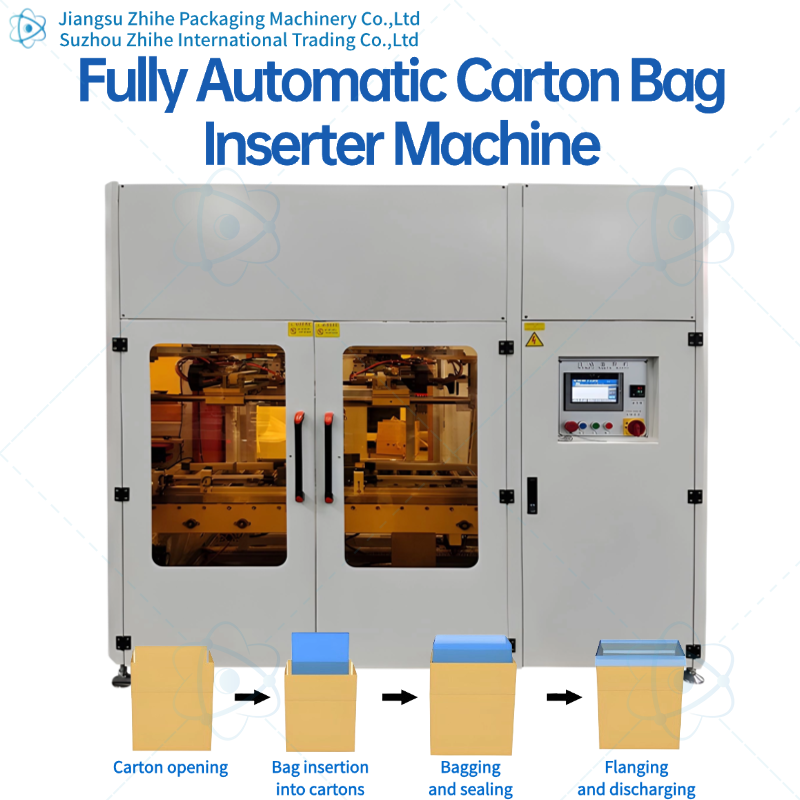
A Fully Automatic Box Bagging Machine is designed to automatically apply a protective plastic bag (typically LDPE or HDPE) over a corrugated cardboard box. Its primary function is to provide a dust-proof, moisture-resistant, and tamper-evident outer layer for finished goods. A typical application workflow is:
A Fully Automatic Box Bagging Machine is designed to automatically apply a protective plastic bag (typically LDPE or HDPE) over a corrugated cardboard box. Its primary function is to provide a dust-proof, moisture-resistant, and tamper-evident outer layer for finished goods. A typical application workflow is:
An empty plastic bag is picked from a magazine and fully opened.
A sealed and labeled box (from upstream like a case sealer) is conveyed into position.
The opened bag is precisely positioned over the box.
The bag is mechanically stretched and fully drawn down over the box.
The excess bag material at the top is gathered, sealed (usually with a heat seal), and trimmed.
The bagged box is discharged, ready for palletizing. This is critical in industries like food & beverage, electronics, pharmaceuticals, and high-value logistics where cleanliness and protection during storage/transit are paramount.
Q:
What types/sizes of boxes and bag materials can this machine handle?
What types/sizes of boxes and bag materials can this machine handle?
A:
The machine is highly configurable within its design range.
The machine is highly configurable within its design range.
Box Compatibility: It is engineered for standard RSC (Regular Slotted Container) corrugated boxes. The machine's adjustable guides and grippers can accommodate a defined range of box lengths, widths, and heights. Common ranges are L: 150-600mm, W: 100-400mm, H: 50-400mm. Extremely tall/slender or unstable boxes may require special handling tooling.
Bag Material: It primarily uses polyethylene (PE) shrink or non-shrink bags.
LDPE Bags: Common for general dust protection; the machine applies them loosely.
HDPE Shrink Bags: After application, the box passes through a heat tunnel where the bag shrinks tightly around the box, creating a sleek, form-fitting package. The machine's bag opening system must be compatible with the bag's gauge (thickness) and slip properties.
Q:
What is the typical operational speed (boxes per minute), and what factors most impact this speed?
What is the typical operational speed (boxes per minute), and what factors most impact this speed?
A:
Typical output ranges from 8 to 20 boxes per minute (BPM). The actual throughput is a function of several variables:
Typical output ranges from 8 to 20 boxes per minute (BPM). The actual throughput is a function of several variables:
Box Size & Stability: Smaller, standard-sized boxes can be processed faster. Larger boxes require more time for the bag to be drawn down. Lightweight or top-heavy boxes may need speed reduction for stability.
Bagging Method: Applying a non-shrink bag is generally a faster, single-step process. A shrink bag application is often faster at the bagging station itself, but the total system speed includes the dwell time in the downstream heat tunnel.
Upstream Consistency: The most critical factor is a steady, consistent, and correctly oriented supply of boxes from the upstream sealer or labeler. Gaps or jams in the infeed are the primary cause of reduced average line speed.
Q:
How is a changeover for different box sizes performed, and what are the key maintenance points?
How is a changeover for different box sizes performed, and what are the key maintenance points?
A:
Efficient changeover and maintenance are crucial for uptime.
Efficient changeover and maintenance are crucial for uptime.
Size Changeover: This involves coordinated mechanical adjustments to accommodate the new box dimensions. Key steps include:
Adjusting the side guides and centering mechanism on the box infeed conveyor.
Adjusting the width of the bag magazine and the gripper arms that open the bag.
Adjusting the height of the bag stretching/drawing mechanism.
On advanced machines, these adjustments are servo-driven and controlled via recipes on the HMI, allowing changeover in 2-5 minutes. Manual adjustments may take 10-15 minutes.
On advanced machines, these adjustments are servo-driven and controlled via recipes on the HMI, allowing changeover in 2-5 minutes. Manual adjustments may take 10-15 minutes.
Key Maintenance Points:
Daily: Clean bag suction cups and optical sensors; clear any plastic debris from sealing jaws and cutters.
Weekly: Inspect and clean the bag separation system (air knives, brushes); check the tension of all drive belts and chains; lubricate guide rails.
Monthly: Inspect the heat sealing element (if equipped) for wear and calibration; check and replace worn gripper pads or suction cups; verify the alignment of all mechanical movements.
Q:
What safety features and optional integrations are available for this system?
What safety features and optional integrations are available for this system?
A:
Safety Features: The machine is fully enclosed with interlocked safety guards. Opening any guard during operation triggers an immediate category 0 (power-off) stop. It includes emergency stop buttons at operator stations, and protective covers over all pinch points and moving parts. Electrical systems comply with international safety standards (e.g., CE, UL).
Safety Features: The machine is fully enclosed with interlocked safety guards. Opening any guard during operation triggers an immediate category 0 (power-off) stop. It includes emergency stop buttons at operator stations, and protective covers over all pinch points and moving parts. Electrical systems comply with international safety standards (e.g., CE, UL).
Common Optional Integrations:
Automatic Bag Loading System: A robotic or vacuum system to automatically load rolls of bags into the magazine, reducing operator intervention.
Inline Shrink Tunnel: A directly connected heat tunnel to shrink the bag immediately after application.
Print & Apply Labeler: To apply a final external label over the bag after shrinking for a clean finish.
Vision Inspection System: To verify bag presence, correct application, and label readability before discharge.
Reject Conveyor: To automatically divert any boxes where the bagging process failed (e.g., no bag, bad seal).