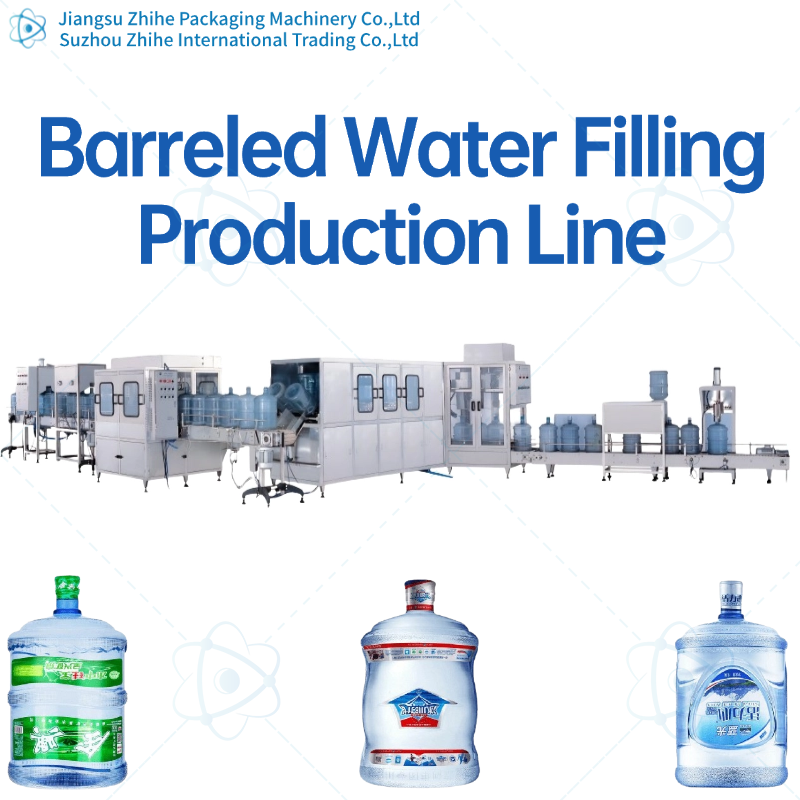

Essential details
MOQ:1
Lead time:30-60 working days
Shipping:Express Delivery, Air freight, Land freight, Ocean freight
Product Introduction


Q: What is the standard workflow of a fully automatic barrel filling line, and how does it ensure zero contamination from empty barrel input to sealed output?
A: The line follows a closed-loop, sequential automation process:
Empty Barrel Handling: Empty barrels (typically 5-gallon/18.9L) are automatically unscrambled, inspected for foreign objects via cameras or sensors, and then conveyed into the system.
Internal & External Cleaning & Sanitization: This is a multi-stage critical process. Barrels undergo pre-rinsing with purified water, followed by a high-pressure internal jet wash with sanitizing solution (e.g., ozone water), and finally thorough rinsing with purified water again to remove any residue. The exterior is also cleaned simultaneously.
Inverted Draining & Air Knife Drying: Barrels are inverted to drain all rinse water completely. High-efficiency HEPA-filtered sterile air knives then dry the interior to prevent dilution.
Filling & Capping: Barrels are positioned under filling heads. Gravity filling or, more commonly, pressure gravity filling is used to minimize foam and ensure precise volume. Filling heads are designed for no-drip retraction. Sanitized caps are then applied and torqued to specification automatically.
Sealing & Labeling: A tamper-evident shrink band or sleeve is applied and sealed via a heat tunnel. Finally, labels are applied, and a final leak or weight check may be performed before output.
Q: What are the key sanitation and sterilization technologies integrated into the line to guarantee water quality and extend shelf life?
A: Maintaining sterility is paramount and is achieved through a multi-barrier approach:
For the Barrel: As described above, using ozonated water or other approved sanitizers (like peracetic acid) in the washing stage is standard. UVC sterilization lamps may also be installed in the rinse area for additional microbial inactivation.
For the Water & Air: The purified water entering the filler passes through a final 0.2-micron absolute filter. All air that contacts the sterile zones—specifically for drying barrels and creating positive pressure in the filler enclosure—is passed through sterile-grade HEPA or ULPA filters (ISO Class 5 equivalent or better).
For the Filling Environment: The critical filling zone is often enclosed and maintained under positive air pressure with sterile air to prevent ingress of ambient contaminants.
Q: What is the typical production capacity (Barrels Per Hour), and what factors primarily determine the maximum speed?
A: Standard lines operate in the range of 80 to 300 barrels per hour (BPH) for 5-gallon sizes. The speed is determined by the bottleneck, which is usually the cleaning and sanitizing cycle time. A line rated for 200 BPH typically means it can process one barrel every ~18 seconds through its slowest station (often the washing stage). Speed is also affected by the filling method—pressure gravity fillers are faster than pure gravity fillers. Higher-speed lines require more parallel stations (e.g., multiple washing and filling heads) and extremely precise synchronization.
Q: How does the system achieve precise filling volume control, and what measures are in place to detect and handle under/overfills or leaks?
A:
Volume Control: Modern lines use mass flow meters or precision load cells under each filling head. The system is controlled by a PLC that receives real-time feedback from these sensors, shutting off the fill valve with high repeatability once the exact target weight/volume is reached. This ensures consistency despite variations in line pressure.
Quality Assurance: An in-line checkweigher is installed after capping. It automatically rejects any barrel outside the preset weight tolerance (indicating underfill, overfill, or missing cap). Some advanced lines also incorporate pressure decay testers post-capping to identify microscopic leaks by detecting a pressure drop in a sealed test chamber.
Q: What is the level of automation and data integration? How easy is it to changeover for different barrel sizes or products?
A:
Automation & Data: The entire line is controlled by a central PLC with a graphical HMI (Human-Machine Interface). It allows for recipe management (for different products), real-time monitoring of OEE (Overall Equipment Effectiveness), speed, and fault diagnostics. Data can typically be exported or integrated into a factory SCADA/MES system for full traceability.
Changeover: Switching between barrel heights or diameters involves mechanical adjustments. Key components like barrel grippers, guide rails, filling head height, and cap chucks are designed for tool-free or quick-change adjustment, often using hand cranks and digital scales. For significant diameter changes, some guide rail sections may need replacement. A well-designed line allows a full size changeover to be completed within 30-60 minutes. All corresponding parameters (height, grip width, fill volume) are stored in the HMI recipe.